Black History Tour of St. Louis Review
 by: Taylor Turner '26
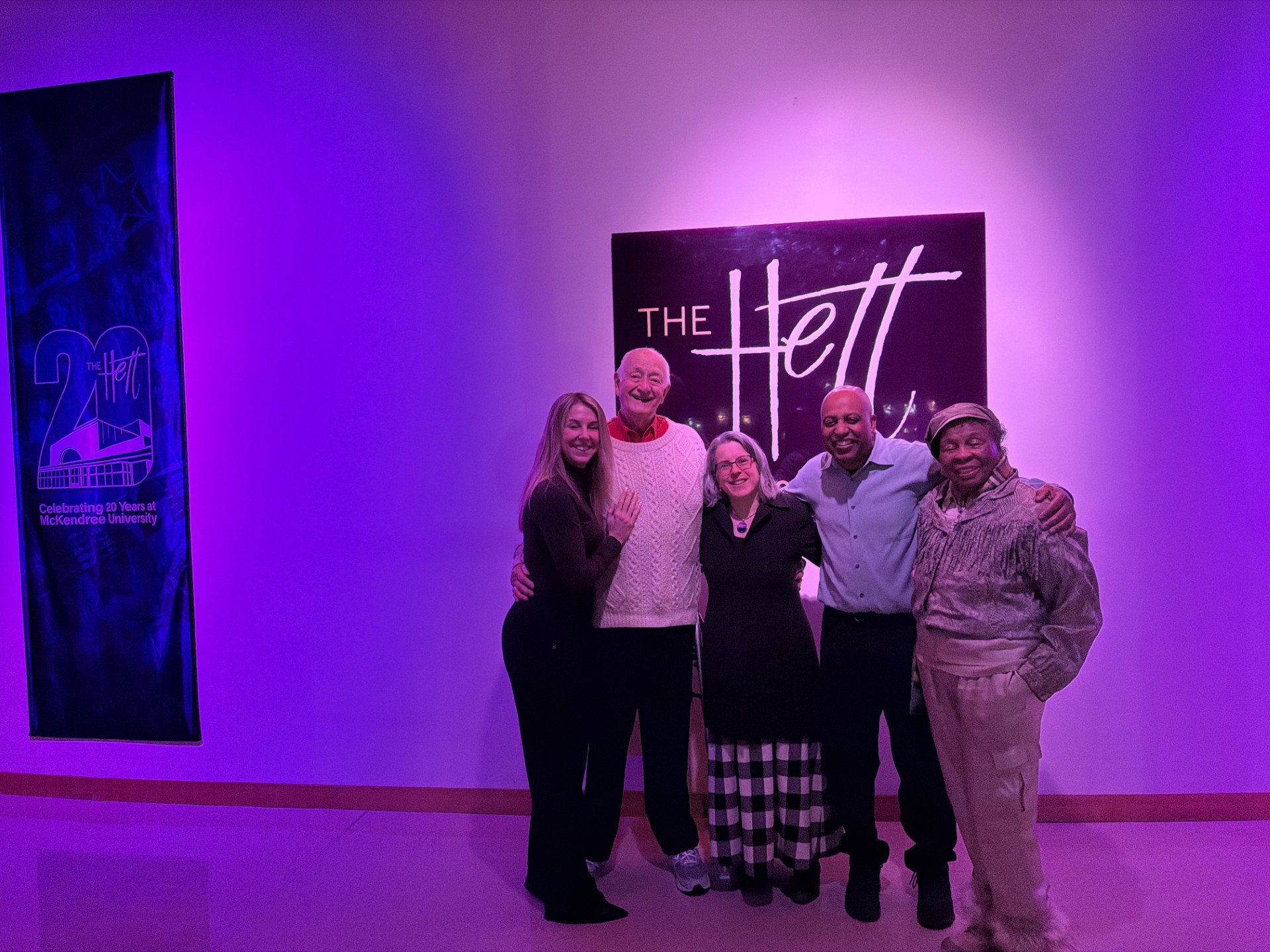
When I attended the screening of A Black History Tour of St. Louis, I didn’t expect to walk away with such a deep understanding of so much history that lives right in our own region. The documentary doesn’t just relive the past but also connects it to the present; it showed how policies, protests, leaders, and everyday citizens changed St. Louis and shaped the city in ways that still matter today. I’m incredibly grateful to the speakers Tony West, Father Kleba, and Jobyna Foster who made the event even more meaningful when sharing their personal insights during the Q&A. The film also included Vivian Gibson, author of memoir The Last Children of Mill Creek, Lynne M. Jackson, the great-great granddaughter of Dred and Harriet Scott, and Father Vince Nyman.
Tony West, the director of A Black History Tour of St. Louis, brought a sense of warmth and energy to the room, carrying a boisterous aura when speaking about his film. West grew up in St. Louis and when he’s not occasionally making films and documentaries, he’s a TV camera operator whose worked for Major League Baseball, the NHL, and the NFL. Father Gerry Kleba was both the tour guide and narrator of the film. Father Kleba is a St. Louis native, where he was a Catholic priest for 59 years. Jobyna Foster is a graduate nurse from the Homer G. Phillips School of Nursing, class of 1957. She has served as head nurse at Homer G. Phillips Hospital and was featured in the documentary, telling her story and experiences with segregation and racism while working as a nurse in St. Louis.
One of the earliest and most striking moments in the film is Father Kleba’s explanation of redlining in St. Louis. He explains how Harland Bartholomew, St. Louis’s first “city planner,” was the one who orchestrated the red lines that divided neighborhoods with racial lines. Father Kleba calls it the “Delmar Divide.” What stood out the most was how Father Kleba pointed out how realtors, banks, loan makers, mortgage lenders, etc., built this system together through collaboration. No one was forced or required to build this system; they all worked collectively to deny Black families access to housing and financial opportunity. Redlining is not an abstract policy, but a coordinated effort to reshape communities, which Father Kleba demonstrates in the film, is still in effect today.
The film also discusses the story of Homer G. Phillips, which Father Kleba describes as “a real voice of social justice in St. Louis.” He explains how Black patients at City Hospital were routinely mistreated and even placed in the basement, physically and symbolically pushed below everyone else. Father Kleba goes on to explain how funds that were originally meant to build a new wing for Black patients at City Hospital were stolen and repurposed, a betrayal that exposed how little the system valued Black lives. In response, Homer G. Phillips pushed forward and helped build a hospital that would properly serve the Black community. His efforts ultimately cost him his life; he was shot and murdered while waiting for a cab before he could see the full impact of his work. His hospital would be later shut down because the city could not afford to run two hospitals, and even though Homer G. Phillips Hospital was newer, with the newest medical equipment, including a new X-ray room with a “new machine that could detect cancer,” Jobyna Foster says in the film, and a brand-new emergency room, the city shut down Homer G. Phillips Hospital.
“I mean, it was wasteful,” Foster says passionately, “and it was just a trick in other words, to try to steer us in the other direction that nothing was happening, which was so cowardly.”
Foster tells her experience with segregation and racism in the film, saying she never heard that word “segregation” growing up and how nobody talked about it; she only heard white and Black and knew the certain stores or neighborhoods of St. Louis she was not welcome in, such as Kresge’s. So, when the two schools of nursing, the Municipal School of Nurses of St. Louis City Hospital and the Homer G. Phillips School of Nursing, had merged for Foster’s graduation, the Municipal School of Nurses sat on one side of the room while Homer G. Phillips nurses, including Foster, sat on the other side. “It was strong segregation in St. Louis at that time,” Foster explains, “and we became a part of it.”
Father Kleba takes us to Visitation Church, where he was a priest, and Visitation School, where in 1946, a “forward-thinking” pastor named John Hamilton Smith was there, so says Father Kleba. He was the pastor that integrated Black students and white students at Visitation School. Father Kleba explains how once the school was integrated, there was an overflow of Black students, and Father Smith bought Quonset huts from the federal government to provide housing for the many Black students. Sisters from Maryknoll Sisters Community with Sr. Fidelia Delaney, who were one of the most respected communities of international missionaries in the world, were sent to St. Louis to teach in an integrated school.
The documentary also highlights the Jefferson Bank protests, which Father Kleba describes as peaceful but firm as some protesters and activists, including Bill Clay and Norman Seay, who chained themselves to the bank doors. As he narrates this chapter of St. Louis history, he makes it clear that the demonstrators were not asking for special treatment—they were demanding employment equality. Percy Green, a civil rights activist, even climbed the unfinished Gateway Arch because there were no Black workers for the Federal project, and was arrested. Father Kleba’s explanation emphasizes that these protests were rooted in dignity. They were not chaotic or reckless; they were intentional acts of resistance and defiance.
The film then moves into more recent history with the death of Michael Brown in Ferguson, a moment that still feels painfully close. As Father Kleba narrates this part of the tour, the tone shifts—there’s a sense of heaviness and urgency that reflects how deeply this event affected St. Louis and the nation. Father Kleba discusses his reason for being present during the protests, how he didn’t know Michael Brown personally, but he was there for Michael’s parents, family, friends, and anyone who knew him and loved him. Father Kleba says, “This tragedy is a dagger in the heart of the Black community in St. Louis.”
“All I know is that if a Black police officer from St. Louis County had shot a white teenager in Sunset Hills, there is no way he would lie in the street for 4 hours and 31 minutes…” Father Kleba says in the film while driving to the location Michael Brown was murdered. During the Q&A session, Father Kleba firmly still agrees with this statement and repeated it once again.
What stood out to me was how the documentary connects Ferguson to the earlier civil rights struggles shown throughout the film. Father Kleba explains how the protests that followed were an outpouring of frustration, grief, and demand for accountability, echoing the same calls for justice seen decades earlier at places like Jefferson Bank and the construction site of the Gateway Arch.
Father Kleba draws attention to the many community gardens scattered throughout the city, the film showing many vibrant fruits and vegetables in small gardens, using them as a quiet but powerful reflection point. As he narrates, he challenges the viewers to think about what they choose to see when they look at these neighborhoods. Do you see only the ugliness and depression that are so often highlighted, or do you see the hope, care, and happiness growing right in the middle of it all? The gardens become more than just plants in the ground; they represent resilience, intention, and a strong sense of unity. Father Kleba’s message is clear: the story of a community depends on where you decide to stand, and whether you choose to recognize the life still flourishing there.
Dr. Martha Patterson was the curator responsible for organizing and bringing A Black History Tour of St. Louis to the Hett and expressed her excitement about sharing this film with the McKendree community. She explains the importance of confronting hard history and celebrating the resilience and achievements of Black communities in St. Louis. As she stated regarding the event:
“Tony West's film, A Black History Tour of St. Louis, powerfully demonstrates how anti-Black racist policies of segregation, redlining, and restrictive covenants created systems of profound disadvantage for Black neighborhoods in St. Louis and in the U.S. as a whole.
“At the same time, as tour guide Father Gerry Kleba explains, Black St. Louisans have also demonstrated extraordinary achievement in Black creative expression, education and professional careers, civil rights protest, and community organizing as integral actors in Catholic social justice initiatives.
“In addition to our guests, Tony West, Father Kleba, and former Homer G. Phillips Hospital nurse Jobyna Foster, I want to thank the many incredible McKendree faculty and our very own University Chaplain, the Reverend Beverly Wilkes-Null, for offering up their time, expertise, and resources to make this event such a success.”
Her words perfectly captured the spirit of the event—one rooted in education, gratitude, and a genuine commitment to bringing meaningful history to us.
Overall, A Black History Tour of St. Louis was a deeply impactful and educational experience that never felt dry or distant. The film balances hard truths with storytelling that still felt engaging, personal, and enjoyable, making the history easier to connect with and understand. Watching it during Black History Month felt especially meaningful, as it didn’t just honor the past—it asked us to think critically about the present and our role in the future. I walked away with a stronger appreciation for the people, places, and movements that shaped St. Louis, as well as gratitude for the speakers who brought this history to McKendree University and took the time to share their stories with students. This documentary proves that learning history can be powerful, honest, and still fun, and it serves as a reminder that these stories deserve to be remembered, discussed, and carried forward.